Adam Hayden: “The best way through fear is familiarity”
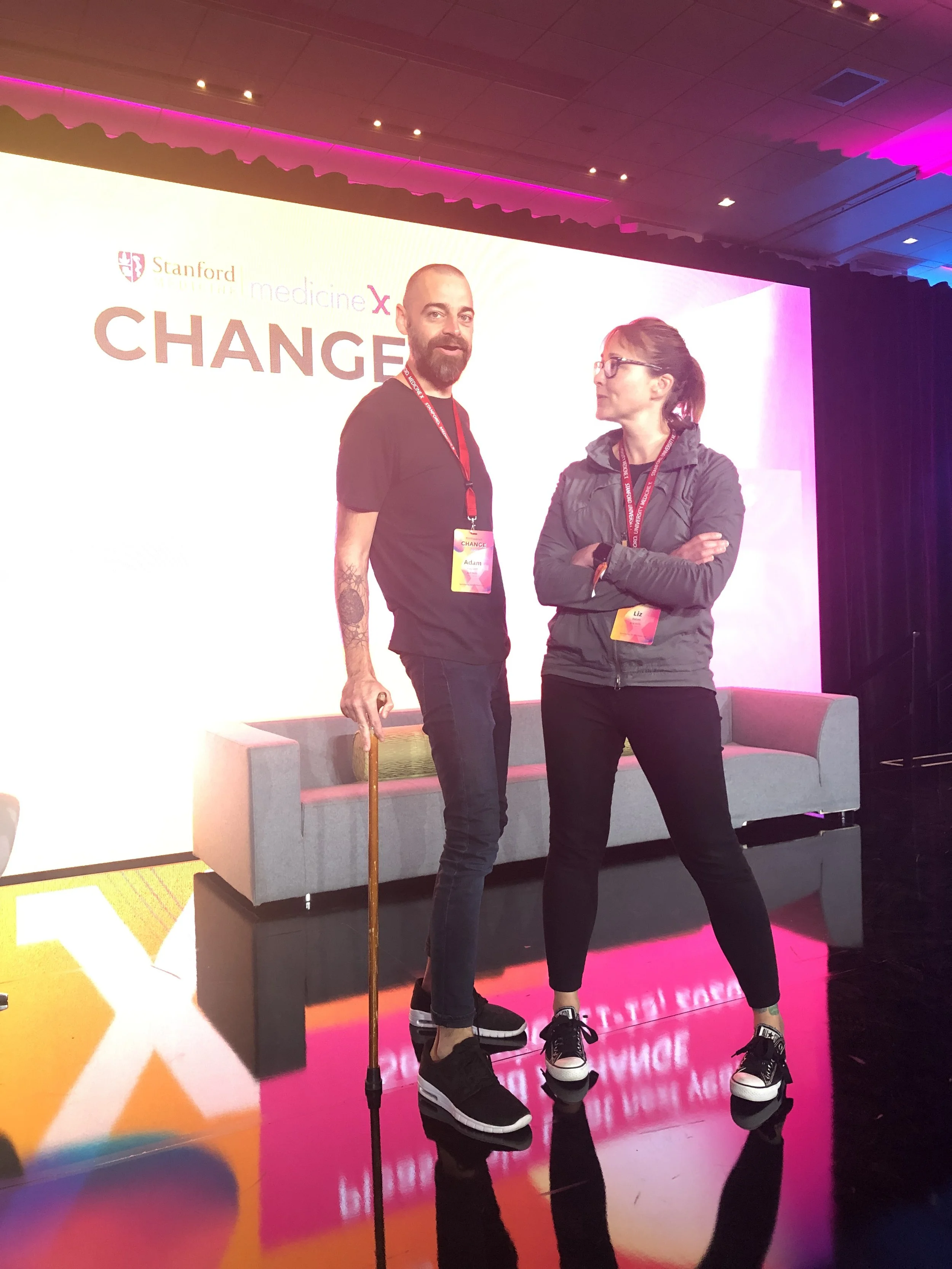
Adam Hayden and Liz Salmi at the Stanford Medicine X meeting in 2019. Photo: Whitney Hayden.
If you are looking for an obituary, official words from National Brain Tumor Society, or a journalistic remembrance, I’ll point you to the links embedded elsewhere. What you’re going to get from me instead is something different: a first-person account from a fellow brain cancer patient-advocate who had the privilege of walking alongside Adam Hayden for nearly nine years.
Also, don’t expect me to write as eloquently as Adam did. Few people could.
Adam and I met the way many brain tumor patient-advocates did in the mid-2010s: on Twitter, through the #BTSM hashtag. Co-founded by me and Charlie Blotner in 2013, #BTSM (Brain Tumor Social Media) became a grassroots, patient-led community where people living with brain tumors—and those who loved them—could talk openly, share resources, and feel less alone in a system that often made us feel invisible.
The first time Adam joined a chat, Charlie and I knew he was different. He dropped a punk rock reference. That alone would have been enough. I followed him immediately, and was delighted to see he was already following me. He quickly became one of my favorite BTFs—brain tumor friends. (If you know, you know.)
Every first Sunday, and then at random hours across time zones, Adam and I DM’d (and later texted). We talked about music. We talked about writing. We talked about being in bands (we both had been). He always had a sharp turn of phrase, the kind that made you pause and reread a sentence.
Jump ahead a few months. In early 2017, I was awake in the middle of the night before an international flight and decided not to bother sleeping. Adam sent me a link to a talk he had just given at a local church about living with glioblastoma.
The video was forty-five minutes long, which is longer than anything I will voluntarily watch while sitting at my computer. But it was the middle of the night, and I wanted to see what this Adam guy was like in real life. I wanted to hear his voice.
And then he said it: “The best way through fear is familiarity.”
I paused the video. Typed the sentence out. And pasted it into the “quotes” section of my Facebook profile. It’s been there ever since.
That single line didn’t just resonate; it quietly re-shaped how I approached survivorship. Not bravery. Not optimism. Familiarity. Learning the terrain well enough that fear no longer had the upper hand.
From that moment on our friendship became a collaboration. From Twitter conversations to starting a research initiative called Brain Cancer Quality of Life Collaborative (now a funding mechanism through National Brain Tumor Society). From talks at Stanford Medicine X (twice) to advocacy through NBTS’ Head to the Hill. From serving together on the NBTS board of directors to research roundtables. From working as undercover as punk-rock agents of change at the Society for Neuro-Oncology annual meetings, all the way to the White House Forum on glioblastoma (where Adam was a featured speaker, ‘natch).
When Adam shared publicly that he had transitioned to home hospice a few weeks before his death, the grief hit me in a way I wasn’t prepared for.
I’ve lost many friends to this disease. Too many. But Adam was different—not because his life mattered more, but because we had built so much together. The grief was physical. I couldn’t breathe. My chest hurt. I cried and laughed at the same time, grateful for nine years of shared language, inside jokes, half-finished ideas, and vivid memories.
Adam knew what a brain cancer death looked like. I did too.
Whitney made a wise request that the community not burden their family with our grief. She was right. Still, I wanted to talk to Adam—not to grieve at him, but to be with him one last time in the way we always were: thinking, laughing, reflecting.
I was approaching finals at school, so I scheduled a call and framed it the only way that felt right.
“In the spirit of back to school,” I told him, “I present our final exam.”
I quizzed him on our shared experiences. True/false. Multiple choice. Short answer. He was completely game. We laughed a lot.
Example: True or False: At Stanford Medicine X, Adam was the only speaker who could reference Kantian moral philosophy and a Minor Threat song in a single sentence.
He answered: True.
Near the end of the call, I asked him one last question.
“What’s one thing I can do to remember you by?”
He told me about his morning ritual: after the kids leave for school, he steps outside, takes a deep breath, and consciously appreciated being alive.
I’ve done it every morning since.
Adam helped shape the patient-researcher-advocate I grew into. Now that he is gone, I feel an even stronger conviction to keep going—to return to school at age 46, to finish the bachelor’s degree I once set aside as a result of my diagnosis, and to live out each of my dreams, no matter how far-fetched, while I still have the chance.
