
Patient & Researcher Blog
Here I aim to capture what I am learning as a newbie researcher from a patient perspective.
Living with a slow growing brain cancer
It is taboo for researchers to talk about their work before it is published.
I think that’s a bummer.
My favorite part about research is learning new things in real time. Here I share my observations as a learner and my n of 1 (personal) findings as a patient.
Note: I started blogging about brain cancer in 2008, at age 29.
I had no background or knowledge about healthcare when I began. Please excuse typos and other misconceptions. What you read here is me in real time, like a time capsule.
There are more than 500 posts here. Use this search to look for something specific. Good luck!
Driving again after seizures
I didn't think too much about driving until early March, when I suddenly felt an overwhelming urge to have my independence back. Who wouldn't feel this way? I'm surprised I lasted this long.
Why didn't anyone tell me how I would feel?
Chemotherapy week was not so bad. I experienced mild nausea Monday through Thursday, but life sucked Friday and Saturday, and I was still nauseated on Sunday.
Snippets from: The Brain that Changes Itself
If you haven't seen me lately, don't even talk to me about the human brain because it's my favorite topic and I won't stop talking for hours. I could talk about neuroscience about as long as I can complain about the improper use of typefaces.
Pre-brain surgery playlist
Here’s the music I listed to on repeat before my last brain surgery.
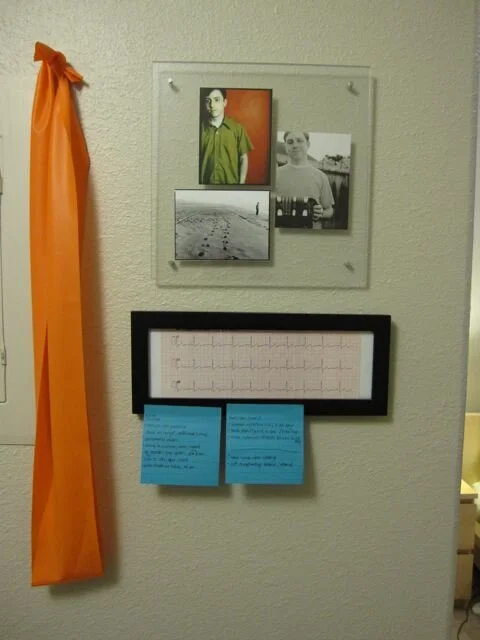
In the bedroom hallway
The orange band and blue Post-It notes remind me to do physical therapy.
This chemo pill thing doesn't seem so bad
I don't want to jinx myself (and I'm only two nights into this) but this chemo pill thing doesn't seem so bad.
I stayed up late for no reason except to enjoy it it
I stayed up late for no reason except to enjoy it it. Brett is playing Resident Evil 2/3/whatever on the Wii. We both keep ourselves entertained each day.
Don't you hate it when biased patient populations mess up the sample?
If grade and age alone were considered for prognosis, these factors would lead clinicians to prescribe unnecessary treatments due to trends reinforced by regional sampling biases.